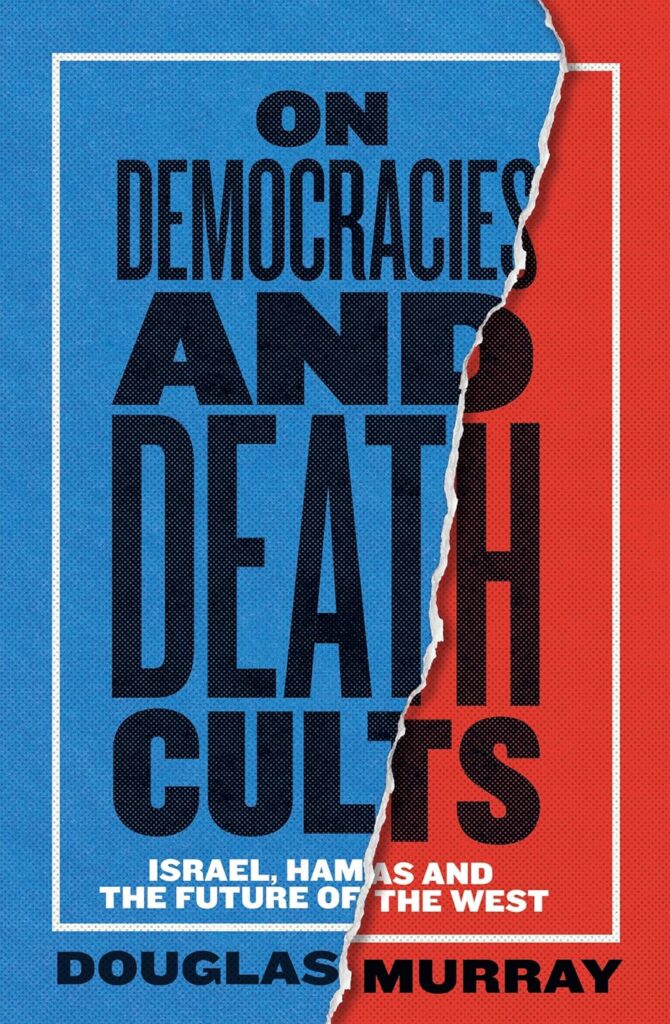
On Democracies and Death Cults by Douglas Murray
Summary
In On Democracies and Death Cults, Douglas Murray examines the moral, political, and cultural fault lines in the West laid bare by the conflict between Israel and Hamas. Drawing on both recent events and broader historical context, he argues that Western democracies have consistently failed to confront terrorism and the ideological “death cult” mindset that drives it. His analysis extends beyond the Middle East, warning that Western political and cultural responses will determine the future stability of liberal societies.
Key Insights
Moral clarity is essential – Democracies cannot defend themselves effectively without acknowledging the moral gulf between open societies and extremist movements.
Terrorism as a death cult – Groups like Hamas operate with a worldview that venerates death, making conventional deterrence ineffective.
Media narratives shape perception – Selective reporting and moral relativism in Western media can distort the nature of the conflict.
Cultural self-doubt weakens the West – A lack of confidence in democratic values can lead to appeasement or paralysis in the face of aggression.
The importance of historical literacy – Understanding the historical roots of both Israel’s existence and Islamist ideology is crucial to meaningful policy.
International hypocrisy – The double standards applied to Israel compared to other nations undermine the credibility of human rights discourse.
The West’s response is a test case – How democracies react to Israel’s fight against Hamas will set a precedent for handling future confrontations with totalitarian ideologies.
Strengths
Moral urgency – Murray’s writing is unapologetically direct, stripping away euphemisms to confront difficult truths.
Clarity of argument – The book distills complex geopolitical and ideological issues into accessible, forceful prose.
Wider cultural lens – Links the Israeli–Hamas conflict to broader trends in Western decline and cultural insecurity.
Weaknesses
One-sided perspective – While persuasive, Murray’s unapologetic defence of Israel leaves little room for counter-arguments or nuance on Palestinian suffering.
Limited policy prescriptions – The book diagnoses problems sharply but offers fewer concrete solutions beyond moral resolve.
Reflections
Murray’s core strength lies in his ability to reframe the Israel–Hamas conflict not as a narrow territorial dispute but as a moral and ideological struggle with global implications. His critique of the West’s cultural weaknesses is particularly striking, especially his warnings about the corrosive effects of moral relativism. For English readers, Murray is a “Marmite man”: few will approach this book without already knowing where they stand on him. As such, it is likely to be read either by those who admire his intelligence and forthrightness or by the rare open-minded left-winger willing to grapple with an adversary’s case.
Conclusion
On Democracies and Death Cults is an impassioned, uncompromising defence of democratic values in the face of violent extremism. It challenges Western readers to shed complacency and confront uncomfortable realities. While its polemical tone may alienate some, its urgency and moral clarity make it an important contribution to the debate about Israel, Hamas, and the resilience of the West. It is difficult to read this book and not be profoundly challenged
Book Details
Title: On Democracies and Death Cults: Israel, Hamas and the Future of the West
Author: Douglas Murray
Publication Year: 2025
Genre: Israel
Reference: APA-08, p.1
← Previous: Guide To Philosophy By Roger Scruton
Next → Deep Work by Cal Newport