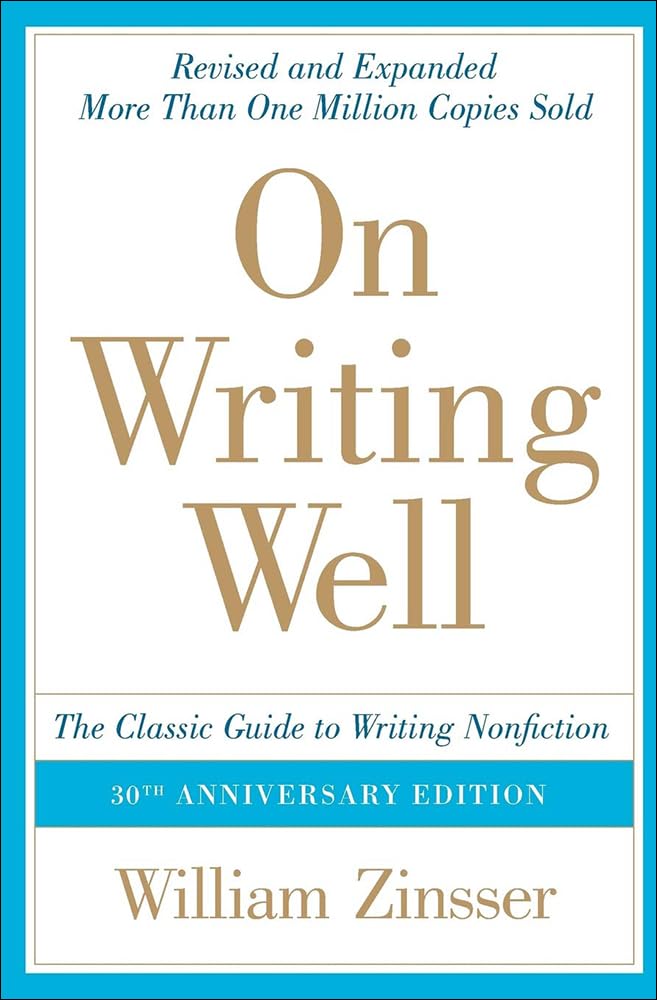
On Writing Well by William Zinsser
Summary
William Zinsser’s classic is a manifesto for clean, confident prose. His thesis: rewriting is the essence of writing, and clarity begins with clear thinking. Cut every needless word, prefer short words, choose strong verbs, and keep the reader’s experience front-and-centre. Zinsser’s “four sisters” are clarity, simplicity, brevity, and humanity; these form a standard for drafting and revising any piece of writing.
Key Insights
Process & Mindset
- Rewriting is non-negotiable; most first drafts can be cut by ~50%.
- Daily practice; writing is hard work and rarely right on the first pass.
- Writing is thinking on paper: keep asking, What am I trying to say?
- Read aloud—sound (euphony) reveals flab and false notes.
Style & Economy
- Prefer short, concrete words; avoid abstract nouns.
- Cut hedges and timid qualifiers (a bit, sort of, rather, quite, very).
- Use strong verbs; avoid adverbs unless they truly change meaning.
- Avoid passive where agency matters—be clear who did what to whom.
- Kill clutter: needless prepositions (“head up” → “head”), empty intensifiers, and signposts (of course, predictably, surprisingly).
Usage & Word Choice
- Choose the precise word: “resign / retire / was fired” beats “stepped down.”
- Beware pompous or fashionable jargon (“prioritise” when “rank” will do).
- Common traps: flout ≠ flaunt; eldest (oldest child) vs. oldest; don’t misuse “myself”; don’t use “too” for “very.”
- If a phrase came too easily, check for cliché.
Structure & Flow
- One point per piece; every sentence should lead logically to the next.
- Paragraphs (not sentences) are the unit of thought; keep them short.
- First and last sentences matter most: the opener hooks R; the closer propels R onward.
- Narrative pulls the train; logic couples the carriages—avoid “breakfast-to-bed” chronology.
Voice & Ethos
- “I’m not selling a subject; I’m selling me.” Write what you would actually say.
- Write for yourself first; you can’t guess R’s preferences.
- Credibility is fragile; precision and honesty sustain it.
- Take obsessive pride in detail; no decision is too small.
- Cultivate the belief that quality is its own reward—and aim to entertain.
Strengths
Ruthlessly practical guidance for drafting and editing at the word, sentence, and paragraph levels.
Memorable principles (clarity, simplicity, brevity, humanity) that travel across forms and genres.
Strong emphasis on sound, cadence, and the power of openings/closings.
Concrete, testable heuristics (read aloud, cut hedges, choose the exact verb).
Weaknesses
Prescriptive tone can feel strict; some usage advice is era- or region-specific.
The bias toward economy may chafe writers aiming for lush or highly lyrical styles.
Focuses more on nonfiction; fiction writers (thinking in terms of C and scene) must adapt examples.
Reflections
Revise, revise, revise! Reading aloud, cutting qualifiers, and making the last word carry weight immediately improve the writing. Zinsser’s reminder that paragraphs are the unit of thought, designed to guide the reader smoothly from idea to idea. I also take to heart “sell me, not the subject”: authenticity beats posturing. I’ll keep his word-choice tests close—swap “assist” for “help,” “implement” for “do,” and be exact about what actually happened. Where I’ll moderate is the near-blanket suspicion of adverbs: if an adverb changes meaning and helps the reader visualise, then perhaps it’s worth keeping.
Conclusion
On Writing Well remains a timeless guide for writers seeking to craft lean and precise prose. By applying Zinsser’s four principles of clarity, simplicity, brevity, and humanity, one can, draft by draft, move closer to what matters: giving the reader an experience that feels effortless because I’ve done the hard work to make it so.
Book Details
Title: On Writing Well: The Classic Guide to Writing Nonfiction: The Classic Guide to Writing Nonfiction
Author: William Zinsser
Publication Year: 2006
Genre: Creative writing
Reference:
← Previous: Stein On Writing by Sol Stein
Next → Story or Die by Lisa Cron