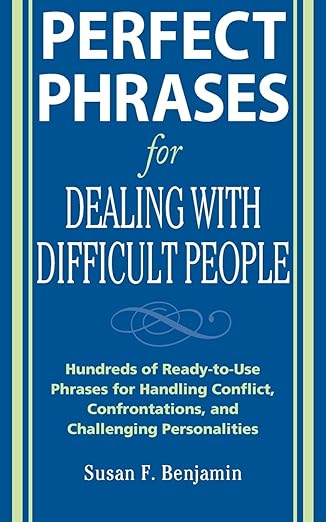
Perfect Phrases for Dealing with Difficult People by Susan Benjamin
Summary
Susan Benjamin’s Perfect Phrases for Difficult People is a toolkit for handling conflict and unprofessional behaviour in the workplace with clarity and composure. The book emphasises objective language, professionalism, and practical scripts to de-escalate rudeness, negativity, and hostility. Rather than reacting emotionally, Benjamin equips the reader with precise, neutral responses that protect dignity, maintain focus on goals, and encourage more constructive behaviour.
Key Insights
Use objective, precise language: Statements like “You interrupted her when she was speaking” are grounded in fact, unlike subjective accusations such as “You ruined the meeting.” Avoid exaggerations like always or never.
Keep professionalism central: Don’t make issues personal—focus on specific behaviour, keep records, and remember your end goal.
Call out disrespect calmly: Respond to rudeness with phrases such as “I would prefer it if you were not rude to me” or “We will get on better if you were not rude to me.”
Handle gossip and negativity: Never repeat negative stories. Instead, redirect with phrases like “I would rather not hear that type of thing” or “Our goal is to …, not to discuss personality traits.”
Challenge subtle hostility: If someone pulls faces or sighs, call it out factually: “You can huff and puff if you want, but it doesn’t alter the facts.”
Reframe negativity into solutions: When colleagues complain, ask “What would you do to improve it?” This shifts focus from problems to constructive action.
Humour at others’ expense: Counter with “That’s funny, but it is not true.”
Meetings and accountability: Assign tasks publicly in meetings to encourage responsibility.
Dealing with anger: Let the person vent without interruption. Encourage them with phrases like “Go on …” to defuse tension before responding.
Career advancement: Don’t let difficult people derail progress. Focus on your own professionalism, build positive last impressions, and leave roles on good terms.
Avoid empty corporate platitudes: Vague phrases like “Provide superior service” lack impact. Be concrete and specific.
Strengths
Highly practical: The book gives concrete, ready-to-use scripts for real-life workplace situations.
Clarity and precision: The emphasis on objectivity and specificity helps prevent miscommunication and escalation.
Balanced tone: The approach strikes a balance between aggression and authority, maintaining professionalism.
Weaknesses
Narrow focus: The book is primarily geared toward workplace settings; some readers may be looking for broader applications.
Assumes a cooperative environment: Advice may fall short in toxic workplaces where leadership fails to address systemic issues.
Formulaic: Relying too heavily on stock phrases could feel stiff or unnatural if not adapted to one’s own voice.
Reflections
Benjamin’s approach reminds me that the key to dealing with difficult people is maintaining composure, objectivity, and professionalism. The power lies in refusing to mirror hostility and instead responding with calm, precise language. I like the technique of reframing complaints into constructive solutions, such as “What would you do to improve it?” because it forces accountability without confrontation.
The reminder that last impressions last longer is also valuable: how I exit a role can shape my reputation as much as how I enter it. Ultimately, the book provides a solid framework for staying in control, preventing escalation, and keeping interactions focused on goals rather than personalities.
Conclusion
Perfect Phrases for Difficult People is a practical guide for anyone navigating challenging colleagues, bosses, or workplace politics. Its emphasis on objectivity, specificity, and professionalism makes it a useful reference for de-escalating conflict and maintaining credibility. While the scripted phrases may need personalising, the underlying principles of clarity, composure, and constructive redirection are universally sound.
Book Details
Title: Perfect Phrases for Dealing with Difficult People: Hundreds of Ready-to-Use Phrases for Handling Conflict, Confrontations and Challenging Personalities
Author: Susan Benjamin
Publication Year: 2007
Genre: Self-help
Reference: Skylark 6, p. 30
← Previous: To Sell is Human by Daniel Pink