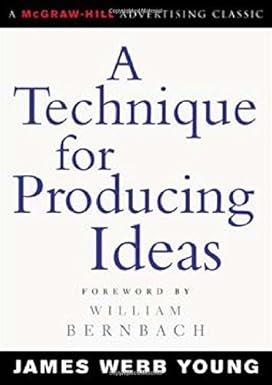
Producing Ideas by James Young
Summary
James Young distils the creative process into a simple, repeatable method. He defines an idea as a new combination of old elements, and stresses that the key to producing ideas is the ability to recognise relationships and patterns between those elements. Drawing on his advertising career, Young offers a structured way to gather knowledge, combine it imaginatively, and refine concepts into workable solutions.
Key Insights
Definition of an idea: A new combination of old elements.
Recognition of patterns: Creativity depends on the ability to see relationships between disparate things.
Two kinds of raw material:
- Specific knowledge — intimate understanding of the domain or subject.
- General knowledge — a wide curiosity about the world.
Broaden your horizons: Treat every facet of life as interesting; actively seek knowledge in unrelated fields.
Cross-fertilisation: Look for solutions in one area that might apply to another.
Incubation: Problems can be solved subconsciously — walking or stepping away from work often triggers breakthroughs.
Refinement: No idea emerges perfect; every concept must be developed and improved before it’s ready.
Strengths
Strips the creative process down to an easy-to-remember framework.
Encourages broad curiosity and cross-disciplinary thinking.
Balances inspiration with disciplined refinement.
Weaknesses
Short and somewhat repetitive — feels more like an extended essay than a full book.
Lacks depth in exploring the psychology of creativity.
Reflections
Young’s method resonates with modern innovation practices, particularly the emphasis on combining knowledge from multiple domains. The advice to treat all aspects of life as potentially interesting is a strong reminder that curiosity fuels creativity. His insistence on refining ideas rather than chasing perfect first drafts aligns with the realities of all creative work.
Conclusion
Young’s framework shows that while having an idea may feel like the goal, the real success lies in the process, gathering diverse knowledge, recognising patterns, and continual refinement. Follow the process, and ideas will come.
Book Details
Title: Producing Ideas – A Technique for Producing Ideas
Author: James Young
Publication Year: 2003
Genre: Science
Reference:
← Previous: The Power of Charm by Brian Tracy