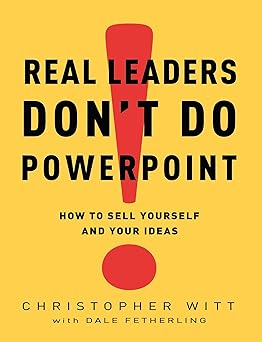
Real Leaders Don’t Do PowerPoint by Christopher Witt
Summary
Christopher Witt challenges the reliance on PowerPoint, arguing that leaders should focus on clarity instead of “hiding” behind slides. The book provides a framework for preparing and delivering speeches that inspire. Witt considers audience research, rhetorical techniques, and again the importance of preparation.
Key Insights
Leadership is expressed not just in words but also in how you dress, move, and behave.
PowerPoint is for conveying information, not vision.
CEOs’ priorities: 1) employees, 2) customers, 3) board of directors.
Know yourself, how you are perceived, and the full context of the event.
Gather details: host, sponsor, planner, attendees, demographics, purpose, timing, and duration.
Treat the audience as partners; answer “What’s in it for me?”
One great idea per speech, summed up in a single sentence and supported by three main points.
Use rhetorical devices: rule of three, repetition, contrast, simile, metaphor.
Remove unnecessary words; favour short, active sentences without adjectives or adverbs.
Be direct — as Churchill said, “use a pile-driver” for important points.
Aim for brevity: most speeches should be under 20 minutes.
Avoid tangents, pleasantries, or apologies; go straight to essentials.
Replace vague phrases like “at this point in time” with precise words (“now”).
The audience decides within 30 seconds whether they like you.
Mild self-deprecation is acceptable; avoid jokes to start.
Present ideas in sequence: Claim → Evidence → Illustration.
Clarity is essential: a confused mind always says no.
Any fool can make something complicated; skill lies in making it clear.
Leaders must be ready to speak at any time — preparation is the golden rule.
Even “off-the-cuff” remarks should be pre-considered.
Stand upright; avoid defensive or distracting body language (“fig leaf,” praying hands, wringing hands).
Never be rude, sarcastic, or respond to insults.
Aim for smiles or chuckles, not belly laughs.
Always define: What’s the big idea? What’s my goal? What do I want them to do?
Notable quotes used: Oliver Wendell Holmes (“Taxes are what we pay for a civilised society,” “Shouting fire in a theatre”), “Fruit of the poisonous tree” (illegally obtained evidence).
Strengths
Packed with practical, memorable tips for improving public speaking.
Covers both content creation and delivery, with emphasis on clarity and respect for the audience’s time.
Good use of rhetorical examples and quotes.
Weaknesses
The anti-PowerPoint argument, while thought-provoking, risks being too rigid for situations where visuals help.
May underplay the skill required to combine brevity with necessary detail.
Reflections
The reminder to do without pleasantries and tangents is with reading. Audiences value efficiency. They hate having their time wasted. The Claim → Evidence → Illustration formula is a simple but powerful tool, and the advice to prepare for extempore remarks is Churchillian. Witt’s focus on precision of language and physical presence is a useful reminder of what makes a good presentation.
The most important thing for me in this book is this: Never waste the audience’s time. Be so respectful of their time.
Conclusion
Real Leaders Don’t Do PowerPoint is not just an anti-slides polemic; it’s a practical manual for concise communication. Witt’s approach emphasises preparation and the oh so important respect for the audience’s time.
Book Details
Title: Real Leaders Dont Do Powerpoint
Author: Christopher Witt
Publication Year: 2009
Genre: Communication and Presentation
Reference: Skylark Vol. 5 p. 48
← Previous: How To Have Creative Ideas By Edward De Bono