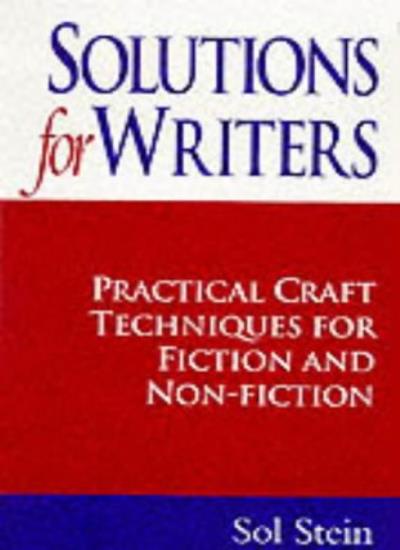
Solutions for Writers by Sol Stein
Summary
In Solutions for Writers, Sol Stein returns to his mission of giving readers an experience superior to their own lives. He distils decades of editorial and teaching practice into pragmatic solutions for common writing challenges: how to open a story with impact, build tension, craft characters, and sustain suspense. His advice is, as ever, precise and practical: every sentence, scene, and chapter must be calculated for effect. Never waste a word.
Key Insights
Purpose & Mindset
- Goal: provide R with a superior experience.
- Read drafts in a monotone (or Mac text-to-speech) to test clarity and rhythm.
- Develop thick skin: learn from what I dislike in others’ books, and cut it from my own.
Openings & Suspense
- First paragraph must excite curiosity.
- First sentence should be intriguing, unusual, shocking, or foreboding.
- Best starts involve conflict, action, or something unexpected.
- Every chapter must contain suspense; without it, the novel sags.
- Arouse suspense but delay resolution; end scenes and chapters in trouble.
Characterisation
- C must want something badly; A must want to stop C just as badly.
- Stakes must be urgent, necessary, and important (stamp collections don’t matter; love, justice, ambition, revenge do).
- Characterise through:
- Physical attributes
- Clothing and accessories
- Psychological traits/mannerisms
- Actions
- Dialogue
- One eccentricity can distinguish a character (“she always sent food back”).
- Ask: what inherited traits or family customs haunt or help C?
- Is C too much like me? If so, change C.
- Limit the story to one Antagonist.
Conflict & Tension
- Tension arises from friction—orders obeyed instantly = no story; resistance = drama.
- Scenes should put C and A on different “scripts,” colliding objectives.
- Use precise time and place to sharpen tension.
- Crucible: why can’t characters walk away?
- Always put obstacles in C’s path; what’s the worst thing that could happen next?
Dialogue
- Checklist: Does it serve a purpose, heighten conflict, provoke curiosity, create tension, or move the story forward?
- Convey info obliquely; never say “C felt…”—show through action.
- Dialogue should be lean, adversarial, and purposeful.
Style & Technique
- Information must come through character action, not author intrusion.
- Action ≠ motion; action is purposeful behaviour.
- Particularise: vivid, surprising details (“Vince coughed from the ground floor up”).
- Descriptions should move from the general (distant) to the specific (close).
- Avoid flashbacks and coincidences; establish credibility by planting details early.
- Shun the first sentence that comes to mind; refine until it surprises.
Strengths
Clear, actionable checklists (openings, dialogue, suspense).
Strong emphasis on tension, suspense, and stakes—keeps writing dynamic.
Practical detail on characterisation: eccentricities, mannerisms, inherited traits.
Encourages ruthless revision and constant testing for effect.
Weaknesses
Stein’s solutions can feel prescriptive; the focus on suspense may not suit every genre.
His “one antagonist” principle, while clean, oversimplifies more complex narratives.
Little tolerance for experimentation; his advice assumes conventional storytelling.
Sol Stein’s Dialogue Checklist Template
For each exchange, ask:
Purpose
- What is the point of this dialogue?
- Does it advance the story, reveal C, or build tension?
Conflict & Tension
- Does the dialogue create friction between characters?
- Are characters on different “scripts” (clashing objectives)?
- If one character complied instantly, would tension vanish?
Curiosity & Suspense
- Does it provoke R’s curiosity—make them want to know more?
- Does it raise a question without answering it immediately?
- Does it leave something unresolved, hanging over the scene?
Impact on Story
- Does it provoke a change (in character, situation, or stakes)?
- Does it escalate conflict, heighten suspense, or increase urgency?
- If cut, would the story lose something essential?
Style & Delivery
- Is information conveyed obliquely (subtext, implication, action) rather than as exposition?
- Am I showing emotions through action rather than writing “C felt…”?
- Is every word lean, purposeful, and in C’s authentic voice?
- Do characters sound distinct from one another (tone, vocabulary, rhythm)?
Pass Test: Dialogue that serves a purpose, sharpens conflict, provokes curiosity, creates tension, and moves the story forward.
Fail Test: Dialogue that merely exchanges information, restates what R already knows, or fills space.
Reflections
For Stein, suspense is the lifeblood of narrative. His insistence that every chapter end in trouble keeps the story taut and forward-driving. It makes the reader want to immediately start the next chapter. Stein’s insists on particularity: thus, not “heavy smoker,” but “coughed from the ground floor up.” It is these concrete touches that bring a description to life.
I also find his reminder to test prose by reading aloud invaluable. Sound reveals weaknesses the eye skims over. And his advice to learn from what I dislike in others’ books is both practical and liberating: instead of only seeking models, I can avoid known pitfalls.
Conclusion
Solutions for Writers is not a book of theory but of practice. It is full of tools, checklists, and principles that can be applied line by line and scene by scene. Stein’s solutions are unashamedly geared toward making fiction compelling: strong characters, relentless tension, purposeful dialogue, and vivid detail. For the working writer, his advice is both a discipline and a toolkit.
Book Details
Title: Solutions for Writers: Practical Craft Techniques for Fiction and Nonfiction
Author: Sol Stein
Publication Year: 1999
Genre: Writing
Reference:
← Previous: Art Of Dramatic Writing by Lajos Egri
Next → Wired for Story by Lisa Cron