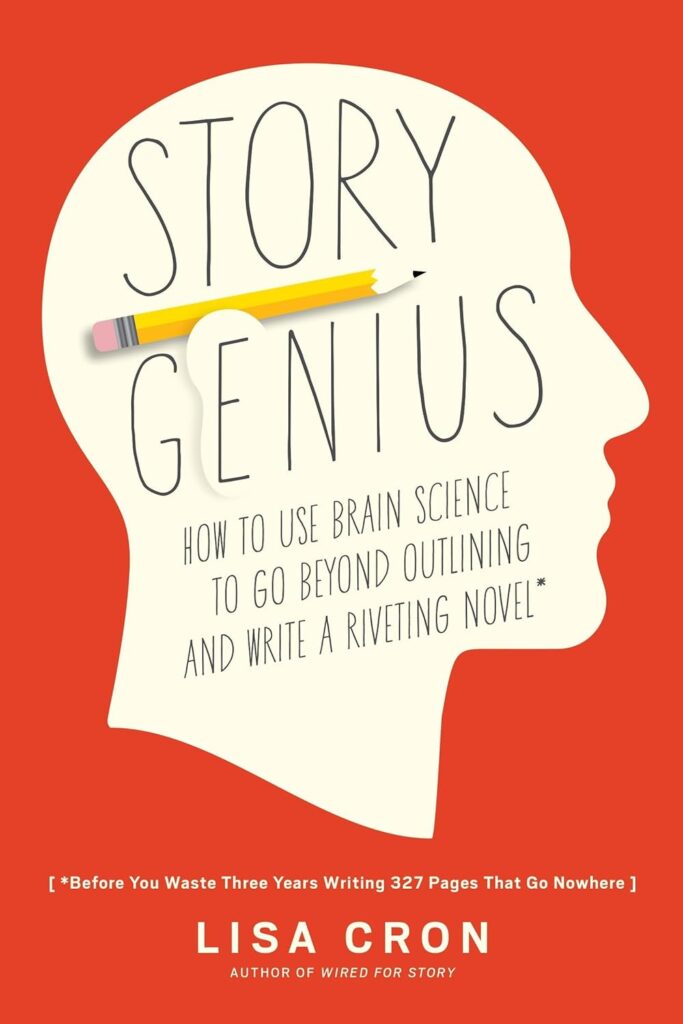
Story Genius by Lisa Cron
Summary
Lisa Cron’s Story Genius digs into the heart of what makes stories powerful: they’re not about external events, but about how those events force a character to face and ultimately overcome an internal misbelief. Cron argues that plot is surface; story is deep. It is an internal struggle of growth and revelation. A novel becomes meaningful when every external obstacle compels a character to confront their misbelief and move toward transformation.
Cron emphasises that stories are not escapism; they are survival tools. Our brains are wired to learn vicariously, to ask, What would I do? Reading fiction gives us practice in navigating real life. The goal is not beautiful prose, but a story that hooks the reader by showing why events matter, what’s at stake, and how they change the character. The result is a narrative that is urgent, purposeful, and meaningful.
Key Insights
A story is not a plot. Plot = external events. Story = how those events change C internally.
All stories are character-driven. C must want something, but an internal misbelief blocks them.
The premise is crucial. From the start, define what C wants, why, and what misbelief holds them back.
Brains crave survival lessons. Stories allow R to learn vicariously how to navigate life.
Conflict is specific to C’s quest. Generic obstacles don’t matter; every problem must hit C’s misbelief.
Escalation is key. Each solution creates a bigger problem, driving deeper internal change.
Every scene must change C. No static events; each “what” must have a “why.”
Endgame: C discards misbeliefs, completing the internal transformation.
Strengths
Clear framework for building story from character’s inner problem outward.
Neuroscience connection—stories are evolutionary survival tools—makes the argument fresh and compelling.
Practical tools: “Five Whys,” scene master card, biography-building questions.
Insists that meaning trumps style: prose matters less than emotional resonance.
Weaknesses
Strongly dismissive of “pantsing” (writing by discovery), which may alienate some writers.
Heavy focus on misbelief as the organising principle can feel restrictive if applied too rigidly.
Occasionally repetitive in hammering home that plot ≠ story.
Reflections
Cron’s insistence that the story is internal change, not external motion, resonates deeply with me. Her example of Hal’s misbelief, that “bad things always happen to me”, shows how a personal, emotional flaw drives everything. It is the tension between his desire to belong and his fear of rejection that fuels the novel, not the surface mechanics of shop inheritances or suspicious deaths.
I particularly value Cron’s neuroscience angle: MRI scans show our brains light up as though we’re living the events ourselves. This validates why stories grip us: they’re survival simulations. A surprise, a conflict, a misbelief challenge, these keep us hooked because they teach us how to navigate the unexpected.
Above all, Story Genius reinforced the mantra: don’t ask “what happens next?” but “why does it matter to the character?” Without that, there is no story, only a sequence of events.
Conclusion
Story Genius is not just another craft book; it is a call to reframe how we think about narrative itself. Cron reminds us that readers don’t come to stories for fireworks or clever prose; they come for meaning. A story works only when every external obstacle drives the protagonist’s internal change, forcing them to confront and discard the misbeliefs that hold them back.
For me, the takeaway is simple yet profound: story is about survival. It teaches us what it means to be human and how to endure. By living vicariously through characters, we face their dangers as if they were our own, and in doing so, we learn from their mistakes without having to make them ourselves. If I keep Cron’s principles in mind, I will always ask, What does this event mean to my character? Then, hopefully, my writing will not just entertain but help the reader navigate life’s perils, just as stories have always done.
Book Details
Title: Story Genius: How to Use Brain Science to Go Beyond Outlining and Write a Riveting Novel (Before You Waste Three Years Writing 327 Pages That Go Nowhere)
Author: Lisa Cron
Publication Year: 2016
Genre: Creative writing
Reference:
← Previous: Wired for Story by Lisa Cron