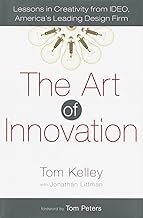
The Art of Innovation by Tom Kelley
Summary
Tom Kelley, of IDEO, distils lessons in creativity and innovation from one of the world’s most influential design firms. The book outlines practical tools such as observation, brainstorming, and rapid prototyping, and emphasises that innovation is a repeatable, learnable process rather than the work of lone geniuses.
By studying real people, visualising novel concepts, refining ideas collaboratively, and building quick, interactive prototypes, teams can move from concept to implementation effectively. Kelley shows that strong leadership, trust, collaboration, and a willingness to take risks all underpin a culture of innovation.
Key Insights
Core innovation skills: observation, brainstorming, prototyping.
Steps: understand the domain, observe real people, visualise, evaluate, refine, implement.
Observe rather than assume; people are often too polite to voice criticism.
Brainstorming rules: focus on the goal, aim for quantity, number ideas, build and jump, use props, avoid “boss goes first” and “black hatting.”
Collaboration beats the lone genius myth; ad-hoc teams keep ideas fresh.
Leadership is about care, trust, and team success, demonstrated through actions.
Reward with experience, not money; tight deadlines can energise teams.
Prototypes are vital: build to learn, spark new ideas, and persuade stakeholders.
Manage by example; avoid excessive hierarchy.
“Show and tell” to share project successes and encourage cross-team learning.
Role play and perspective-shifting can spark unconventional ideas.
All skills are learnable; focus on verbs (actions) rather than nouns (things).
Innovation implies risk: fail often to succeed sooner.
Strengths
Rich with practical, actionable tips grounded in real-world experience.
Busts common myths about creativity, replacing them with workable processes.
Excellent use of anecdotes and stories to illustrate points.
Weaknesses
Heavy focus on IDEO’s culture; some lessons may not translate directly to all organisations.
Occasionally jumps between topics, making it more a toolkit than a single, cohesive narrative.
Reflections
Kelley’s approach to innovation is unpretentious. He argues that building prototypes quickly and cheaply drives learning. His observation about politeness masking real feedback is valuable; he claims that sometimes the only way to know how people truly react is to watch them. His emphasis on collaboration over the “lone genius” myth and the reminder that all skills can be learned are well-known but worth repeating. The principle of focusing on verbs rather than nouns is one I need to learn. Actions create value.
Conclusion
The Art of Innovation is a practical manual and an inspiring call to action for people wanting to foster creativity. Innovation should never be a lucky accident, and by embracing habits of observation, structured brainstorming, and rapid prototyping, innovation can become a consistent outcome. Kelley shows that with the right mindset and tools, creativity is accessible to all.
Book Details
Title: The Art of Innovation: Lessons in Creativity from Ideo, America’s Leading Design Firm
Author: Tom Kelly
Publication Year: 2001
Genre: innovation
Reference: Skylark Vol. 5 p. 10
← Previous: The Lean Start Up By Eric Reis