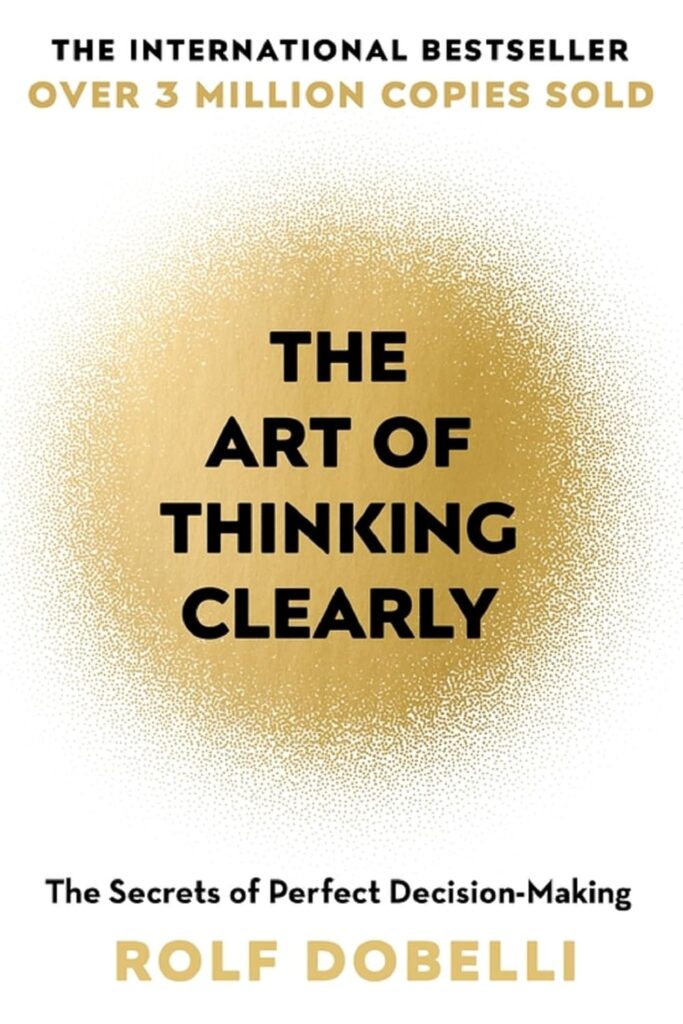
The Art of Thinking Clearly by Rolf Dobelli
Summary
Rolf Dobelli’s The Art of Thinking Clearly is a catalogue of the mental traps and cognitive biases that distort human judgment. Through concise, story-driven chapters, Dobelli introduces readers to over ninety biases, from survivorship bias to the planning fallacy, and shows how these thinking errors influence our decisions in all areas of life. His aim is not to make us perfectly rational, but to help us avoid the most common and costly mistakes.
Key Insights
Classic Biases and Illusions
- Survivorship bias: We overestimate our chances of success by only looking at the winners (e.g., successful musicians) and ignoring the unseen majority who failed.
- Swimmer’s body illusion: We confuse selection effects with training effects, mistaking cause for consequence.
- Clustering illusion & pareidolia: We see patterns in random events, whether bomb strikes on wartime maps or faces in clouds.
- Confirmation bias: We seek evidence that supports our views and ignore contrary data—Darwin trained himself to record exceptions to combat this.
- Authority bias: Milgram’s obedience experiments showed how people defer to authority figures, even against their conscience.
- Availability bias: We overvalue the information that comes most readily to mind, such as words beginning with “K.”
Decision Traps
- Sunk cost fallacy: We persist in bad investments or failed projects because we’ve already invested resources (Concorde, Vietnam War). The rational question: “Would I still do this if I had invested nothing yet?”
- Outcome bias: We judge decisions by results rather than the quality of the reasoning behind them.
- Regression to the mean: Improvement after a slump may be random fluctuation, not effective intervention.
- Anchoring: Our estimates are biased by reference points, often manipulated by salespeople.
- Gambler’s fallacy: We think past coin tosses influence future ones.
Social and Emotional Biases
- Reciprocity: Even trivial gifts create obligations, a principle exploited by salesmen.
- Social proof & herd instinct: We conform to group behaviour, even when wrong.
- Liking bias: We prefer people who flatter us or resemble us, making us easy marks for sales tactics.
- Groupthink: Suppressing dissent leads to disasters like the Bay of Pigs.
- Envy: As Aristotle noted, “potters envy potters”—competition breeds jealousy, often destructively.
Illusions of Control and Knowledge
- Illusion of control: We believe placebo buttons at crossings influence traffic lights.
- Chauffeur knowledge: Reciting facts is not the same as true understanding. True experts know their limits.
- Forecast illusion: Most predictions are barely better than guesses; always check track records.
- Dunning–Kruger effect: The incompetent often lack the ability to see their incompetence.
Economic and Behavioural Traps
- Loss aversion: We fear losses more than we value equivalent gains, which salespeople exploit (“I don’t want you to miss out”).
- Scarcity effect: “Today only” or “while stocks last” prompts irrational urgency.
- Endowment effect: We overvalue what we own, such as our house.
- Winner’s curse: Auction winners tend to overpay.
- Zero-risk bias: We irrationally prefer eliminating small risks entirely rather than reducing large risks substantially.
Practical Wisdom
- Less is more: Too much choice paralyses decision-making.
- Decision fatigue: Mental energy depletes with each choice—glucose helps.
- Pre-mortem: Before launching a project, imagine it has failed and ask why.
- Zeigarnik effect: Unfinished tasks nag at us until completed.
- Buffett’s principle: The real skill is not solving complex problems, but avoiding them.
Strengths
Breadth of coverage: Dobelli’s short chapters make complex psychological concepts accessible and memorable.
Engaging anecdotes: Stories from Darwin, Milgram, Planck, and even Aesop bring the biases to life.
Practical application: Offers tools like asking “Would I still do this if I hadn’t started yet?” to counter sunk costs.
Weaknesses
Some chapters oversimplify nuanced scientific research.
Readers familiar with Kahneman, Tversky, or Taleb may find little new.
The quick, almost aphoristic style may feel superficial for those seeking depth.
Reflections
The book reminded me how easily the mind deceives itself. The “sunk cost fallacy” struck me hardest: how often do I persist in unwise commitments because of past investment? Similarly, the advice to perform a “pre-mortem” feels invaluable; imagining failure before it happens forces clear-eyed thinking.
I was also challenged by Dobelli’s reminder that anecdotes, while sticky and persuasive, are not evidence. His point that “the greatest obstacle to discovery is the illusion of knowledge” resonates across disciplines: humility is a safeguard against self-deception.
Conclusion
The Art of Thinking Clearly is a practical field guide to human folly. Dobelli does not promise to eliminate cognitive errors but to help us recognise them, question our assumptions, and avoid the worst mistakes. For anyone who makes decisions in any capacity, this book is a compact and valuable companion.
Book Details
Title: The Art of Thinking Clearly: The Secrets of Perfect Decision-Making
Author: Rolf Dobelli
Publication Year: 2014
Genre: Psychology
Reference: Calandra 6
← Previous: Asshole Survival Guide by Robert Sutton