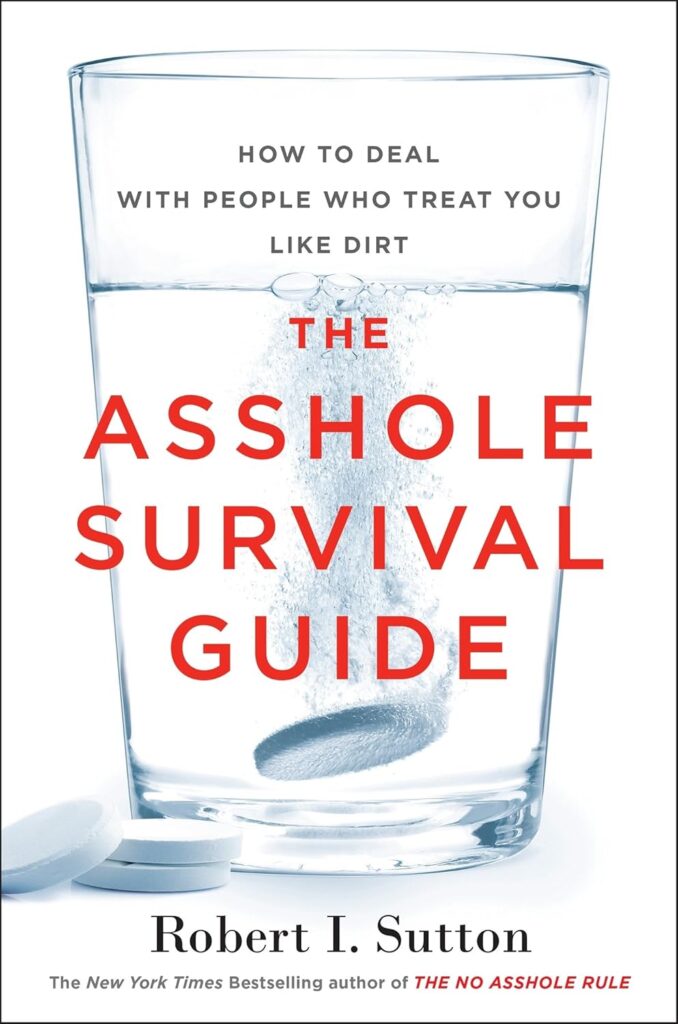
The Asshole Survival Guide: by Robert Sutton
Summary
In The Asshole Survival Guide, Robert Sutton builds on his earlier book The No Asshole Rule by offering practical strategies for dealing with unpleasant people. Sutton acknowledges that difficult personalities are everywhere, from petty tyrants with small amounts of power to abusive bosses, and provides tools for recognising, reframing, and responding without losing dignity or health. The book is a manual for survival and a reminder to look inward: sometimes the “asshole” is us.
Key Insights
Recognising the Problem
- Be slow to label others, but quick to recognise the behaviour in myself.
- Key test: do I leave others feeling demeaned, disrespected, or drained? If so, I’m the problem.
- One-off sharpness is human; repeat offences create a toxic reputation.
- The rudeness of strangers can stay with us for life, highlighting the lasting impact of incivility.
Why People Stay in Toxic Situations
Sutton lists ten reasons why people endure abusive bosses or workplaces: it doesn’t seem “that bad,” they hope it will improve, they don’t want to be quitters, they’ve invested too much, or they believe it will be worse elsewhere. Over time, staying too long normalises mistreatment.
- Lesson: Don’t be afraid to walk away. Most people leave bosses, not companies.
Contagion of Incivility
- Ill-treatment is contagious—demeaning behaviour spreads quickly, especially via email or meetings.
- Petty tyrants with low status often exploit their limited power.
- Good leaders shield their teams: “My job is to hold the umbrella so the rubbish doesn’t hit you. Your job is to keep me from having to use it.”
Coping Strategies
- Pause before reacting: when someone shouts, wait a few seconds before replying.
- Talk slowly and softly to de-escalate.
- Reframe: remind yourself their behaviour reflects on them, not you.
- Mundane replies (“I appreciate your input,” “I see where you’re coming from”) defuse conflict.
- Don’t retaliate: revenge corrodes the avenger. Forgiveness improves health and self-esteem.
- Leave stress at work: don’t bring toxicity home.
The Power Trap
- Power often brings out the worst: arrogance, bullying, disrespect.
- Overconfidence leads to poor decisions and damages relationships.
- Sutton’s antidote: humility, courtesy, and remembering that “it is never clever to be rude.”
Positive Actions
- Protect others from toxic behaviour.
- Use the reverse Franklin rule: do a small favour for someone you dislike—positive deeds can shift emotions.
- Treat everyone with courtesy and respect; civility is a safeguard against becoming what we despise.
- Clementine Churchill once told her husband Winston, “I have noticed a deterioration in your manner, and you are not as kind as you used to be.” A reminder that even great leaders need to guard against lapses in decency.
Strengths
Practical toolkit: Concrete advice for coping with abuse, from reframing techniques to exit strategies.
Balanced perspective: Encourages self-reflection as well as strategies for handling others.
Engaging anecdotes: Stories like Captain Holly Graf’s abusive command or Obama’s “When they go low, we go high” illustrate points memorably.
Weaknesses
Some strategies may feel overly simple (e.g., stock phrases) in severe situations.
Focuses heavily on the workplace—less coverage of personal or family relationships.
Reflections
I found Sutton’s emphasis on humility and restraint striking. The reminder that “every time I lose my temper, I diminish myself” is certainly a lesson that this writer needs to learn. His advice to delay, reframe, and respond with courtesy instead of anger is one that I wish I had paid closer attention to.
The book also challenged me to watch my own behaviour. Am I leaving people feeling energised and respected, or demeaned and drained? Sutton insists that decency and good manners are not weaknesses but safeguards against the corrosive effects of power and stress.
Conclusion
The Asshole Survival Guide is a practical and humane manual for navigating toxic workplaces and relationships. Sutton’s message is clear: while we cannot eliminate assholes from our lives, we can choose how to respond, protect ourselves and others, and avoid becoming one ourselves. Civility, patience, and respect are not just survival strategies. They are the markers of real strength.
Book Details
Title: The Asshole Survival Guide: How to Deal with People Who Treat You Like Dirt
Author: Robert Sutton
Publication Year: 2017
Genre: Assertiveness
Reference: Calandra 6
← Previous: The Code of Trust by Robin Dreeke