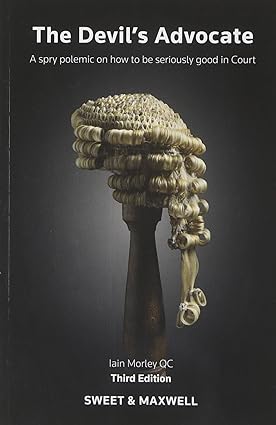
The Devil’s Advocate by Ian Morley
Summary
Morley’s book is a practical manual on courtroom advocacy. He stresses that advocacy is not a quest for truth but a skill of persuasion, conducted within the bounds of integrity and respect. Preparation, politeness, clarity, and deference to the judge are key. The advocate’s role is to guide, not instruct, the tribunal, always inviting agreement, never forcing it.
Courtroom presence matters: dress well, stand tall, avoid distracting habits, and speak with clarity and gravitas. Thorough preparation, brevity, and precise questioning are vital, as is respect for all court staff. Above all, never be rude, arrogant, or angry; such lapses undermine credibility instantly.
Key Insights
Advocacy is a skill that can be taught.
Courtroom persuasion is not about truth but about guiding the judge to your position.
Always maintain honesty, politeness, and clarity; never mislead the court.
Understand the judge’s perspective and aim to please the tribunal without flattery.
Invite agreement (“you may agree…”) rather than forcing it (“you must agree…”).
Never embarrass the judge or cause them to lose face.
Dress and posture signal professionalism; avoid fidgeting, hiding, or appearing fearful.
Speak slowly, with a deep, clear voice, and make eye contact.
Avoid arrogance, condescension, irritation, or pomposity.
Prepare thoroughly: read all paperwork multiple times, write the closing speech first, and elicit only what’s needed from witnesses.
Be brief; repetition weakens arguments.
Treat all court staff respectfully.
Visit the court beforehand to remove logistical uncertainties.
Strengths
Packed with practical, experience-based advice.
Balances courtroom strategy with personal presentation and professionalism.
Strong emphasis on integrity and preparation.
Weaknesses
Some advice on appearance may feel dated or overly prescriptive.
Less focus on the nuances of different types of cases or judges.
Reflections
Morley’s principles, professionalism, courtesy, preparation, and integrity are not just the hallmarks of a good advocate; they are the hallmarks of a good professional in any field. His guidance on respect, clear communication, and meticulous preparation transcends the courtroom.
This is a great book if you’re a Rumpole fan.
Conclusion
This is an unapologetically practical guide, rooted in the realities of courtroom advocacy. While some style tips may feel old-fashioned, the underlying principles of respect, preparation, and controlled persuasion remain timeless.
Book Details
Title: The Devil’s Advocate
Author: Ian Morley
Publication Year: 2015
Genre: law
Reference: Skylark vol. 3, p. 70
← Previous: The Power of Self-Confidence by Brian Tracy