The Elements of Style by William Strunk
Summary
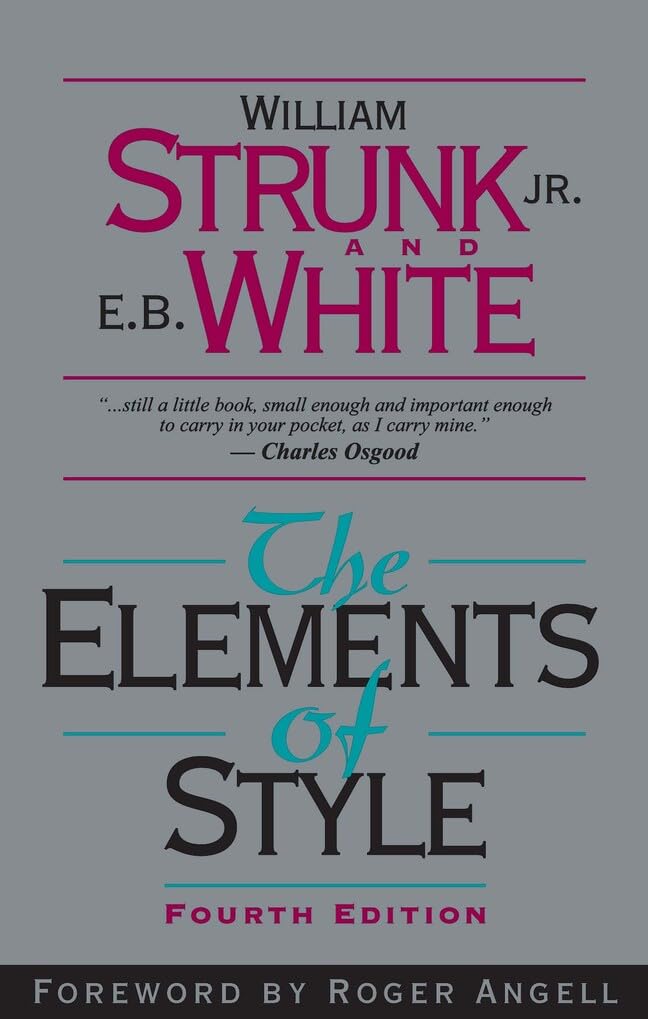
William Strunk and E. White’s The Elements of Style remains one of the most enduring guides to good writing. Its principles are deceptively simple: be clear, be precise, and never waste words. Every paragraph must have a single purpose, every sentence a definite subject and verb, and every word must earn its place. The authors champion the active voice over the passive, concrete details over vague abstractions, and positive forms (“he was late”) over negatives (“he was not often on time”). The book is filled with sharp examples that expose weak habits and offer stronger alternatives. At its heart is the golden rule: good writing is lean, specific, and direct.
Key Insights
Each paragraph must have a purpose like functions in software engineering. A paragraph should do one thing well.
A paragraph should have one topic. Stick to it.
Prefer the active to the passive (but don’t be silly about it).
Beware nounification – Perfer “The are was surveyed” to “A survey was conducted”
Avoid “nots”. Prefer “He was usually late” to “He was not often on time”;
Avoid negatives: Prefer “I forgot” to “I didn’t remember”
The reader has to translate words into meaning; the more concrete and specific, the easier it is. Aim for precision and prefer the concrete over the abstract.
The Golden Rule: Brevity, not a single wasted word.
No loafers – every word must pull its weight.
- He is a man who – he
- His tale is a strange one – his tale is strange
- Owing to the fact – since (because)
- In spite of – although
- In many cases – many
- As to whether – whether
“Effect” is the result; “Affect” is the influence
Strengths
Widespread influence. Few style guides have shaped writing as much as Strunk and White. Generations of writers, journalists, and students have learned its principles, making it a shared reference point in schools and publishing.
Conciseness. The book itself practices what it preaches: it’s short, tightly written, and memorable. It models brevity and clarity.
Practical rules. Its maxims (“omit needless words,” “use the active voice”) are easy to grasp and immediately actionable, even for beginners.
Focus on clarity. By urging writers to prefer concrete over abstract, specific over vague, and positive over negative phrasing, it elevates communication.
Enduring relevance. Even though some examples feel dated, its core advice — write clearly, directly, and with purpose — is timeless.
Cultural cachet. Because so many writers have been trained on it, referencing The Elements of Style carries weight; it’s a book that signals seriousness about writing.
Weaknesses
Overly prescriptive. Strunk and White present their rules as absolutes (“Never use the passive voice”), when in reality, effective writing often requires flexibility.
Simplistic at times. Its brevity is a strength, but it sometimes oversimplifies nuanced issues of grammar, usage, or style.
Inconsistent advice. Linguists have pointed out that Strunk and White sometimes break their own rules in the book’s examples.
Outdated usage. Some recommendations reflect early–20th century American English and don’t always align with contemporary practice.
Neglect of broader writing concerns. It focuses on sentence-level clarity, but says little about narrative, argument structure, or persuasion — crucial skills for writers.
Stifling for beginners. In its attempt to enforce clarity, it can make novice writers self-conscious and rigid, discouraging experimentation or voice.
Reflections
When I first read Strunk and White, I was struck by how much of their advice seemed obvious—and yet how often I was guilty of breaking it. “He was not often on time” feels acceptable until you see how much punchier “He was usually late” becomes. Their insistence on precision still resonates: abstract phrases like “cruel habits” are pale shadows compared with the vividness of “bear-baiting” or “bull-fighting.” For me, the greatest value of the book lies in its relentless focus on the reader. Strunk and White remind us that clarity is not an ornament but a courtesy.
Conclusion
The Elements of Style remains a landmark in writing instruction. Its strengths are obvious: brevity, clarity, and a set of practical rules that have shaped generations of students, journalists, and novelists. Its influence has been so widespread that many of its maxims have entered the bloodstream of English prose. Yet, its very authority can also be a weakness. Strunk and White’s advice is sometimes too rigid, outdated, or simplistic, and their absolutes can stifle rather than liberate. The book is best treated as a toolkit rather than a commandment: invaluable for instilling precision and concision, but not the final word on how writers should express themselves. Read it, absorb it, then learn when to bend or even break its rules in the service of style, persuasion, and voice.
Book Details
Title: The Elements of Style
Author: William Strunk, E. White
Publication Year: 1999
Genre: Creative writing
Reference:
← Previous: Hooked by Les Edgerton