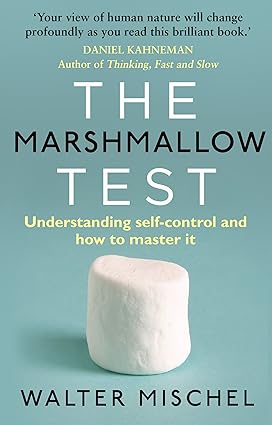
The Marshmallow Test by Walter Mischel
Summary
Walter Mischel’s The Marshmallow Test explores the science of self-control, showing how our ability to delay gratification influences success, health, and happiness. Drawing from decades of research, beginning with his famous experiments offering children a choice between one marshmallow now or two later, Mischel explains how self-control is not fixed, but a skill that can be strengthened. The book aims to help us resist temptation and make better decisions.
Key Insights
Self-control is learnable — Techniques such as “If-Then” planning (“If X happens, then I will do Y”) become automatic with practice.
Nature and nurture both matter — A predisposition is not a predetermination; genes influence behaviour, but environment and training can reshape it.
Consistency is rare — We may excel at self-control in one area (fitness) yet fail in another (tidiness).
Optimism fuels persistence — Believing you can change improves health, resilience, and goal achievement.
Future self-connection matters — The more vividly we imagine our future selves, the better we act in the present.
Cool vs. hot thinking — Cool, abstract thinking helps resist temptation; hot, vivid thinking helps motivate action.
Self-distancing reduces emotional pain — Viewing a setback as a “fly on the wall” observer helps recovery.
Rejection literally hurts — Social exclusion activates brain regions linked to physical pain; even painkillers can help.
Motivation, not willpower, runs down — Reframing a goal can reignite drive.
Mental reframing works — Viewing a tempting drink as “sewage water” or a “rotten fish” can break desire instantly.
Strengths
Rich blend of research, personal anecdotes, and practical strategies.
Offers immediately usable mental techniques for managing temptation.
Challenges the idea that self-control is purely genetic or fixed.
Weaknesses
Some examples (e.g., extreme disgust imagery) may feel too artificial or unrelatable.
The breadth of material sometimes dilutes focus on the original marshmallow study.
Subsequent researchers have questioned the replicability of Mischel’s original findings, and some argue that the children who resisted did so mainly by distracting themselves rather than by exercising innate self-control.
Reflections
This book reinforces the empowering belief that no habit or characteristic is beyond change. The emphasis on vividly imagining my future self serves as a useful motivational tool and aids in making better decisions today. The “cool” vs. “hot” thinking framework is simple but powerful: cool it to resist temptation, heat it to act. The reframing examples, while sometimes extreme, are a strong reminder of how perception shapes behaviour.
Conclusion
The Marshmallow Test is both a scientific deep dive and a practical manual on self-control. It shows that resisting a marshmallow, or any temptation, isn’t about gritting your teeth but about reshaping your mind. With practice, the skills Mischel describes can improve not just willpower, but the overall quality and direction of life.
Book Details
Title: The Marshmallow Test: Understanding Self-control and How To Master It
Author: Walter Mischel
Publication Year: 2015
Genre: Psychology
Reference: Skylark Vol. 5 p. 84
← Previous: How To Get A First By Thomas Dixon