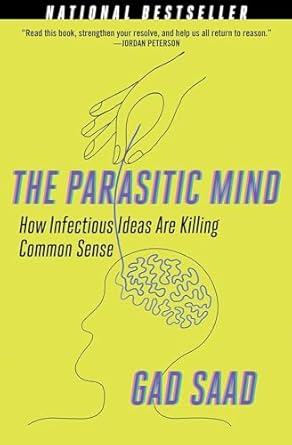
The Parasitic Mind by Gad Saed
Summary
Gad Saad argues that academia and public discourse have been “infected” by several harmful. He includes: political correctness, identity politics, and ideological dogma. These, he likens, to “mind parasites”, which, Saad asserts, undermine truth-seeking, suppress free speech, and reward victimhood. His examples range from historical (Trofim Lysenko under Stalin) to contemporary (hate crime hoaxes, faux outrage, and identity-based reasoning).
Key Insights
Idea pathogens work like biological parasites, distorting thinking and leading to destructive outcomes.
“OPS” — Ostrich Parasitic Syndrome — describes the wilful avoidance of truth for ideological comfort.
Freedom is not inherited; it must be actively defended.
Satire, irony, and mockery are vital tools for testing the resilience of ideas.
The price of living in a free society is tolerating the risk of being offended.
Voltaire’s warning: “Those who can make you believe absurdities can make you commit atrocities.”
Cultural preferences (e.g., spicy food in hot climates) often have practical origins.
Examples of political and cultural hysteria — from the Matt Taylor shirt controversy to fake hate crimes — illustrate how outrage can be weaponised.
The quest for truth is not the same as the desire to be right.
The concept of “sneaky f*ckers”: men adopting feminist or environmentalist positions not out of conviction, but to increase their chances with women.
Offence is the price of a free society; nothing should be immune from satire or mockery.
Strengths
Wide-ranging, eclectic mix of historical, scientific, and cultural references.
Memorable anecdotes, such as the case of Matt Taylor, the scientist criticised for wearing a “sexist” shirt, which was a gift from a female colleague. This episode encapsulates the performative and inconsistent nature of some public outrage.
Engaging, combative style that keeps the reader’s attention.
Strong defence of free speech without hedging.
The “sneaky f*ckers” idea is a rare, sharp behavioural insight.
Weaknesses
Tone may alienate those who don’t share Saad’s worldview.
The breadth of topics sometimes sacrifices depth.
The central analogy — academic or social theories spreading like a virus — is serviceable but not particularly original or deep.
Heavy reliance on anecdotal and media examples rather than sustained data analysis.
Reflections
While Saad is right to criticise ideological conformity and the erosion of free inquiry, his “mind parasite” analogy feels more like rhetorical packaging than genuine conceptual breakthrough. An effective analogy should illuminate; here, it risks oversimplifying complex social dynamics. That said, his discussion of opportunistic male behaviour (“sneaky f*ckers”) and the Matt Taylor incident are valuable case studies in hypocrisy and selective outrage.
“The price of living in a free society is the risk of being offended.”
Conclusion
The Parasitic Mind is an argumentative defence of free thought and a warning against intellectual groupthink. Its overbearing tone and weak central analogy diminish its impact, but there are still moments of genuine insight. Saad is at his best when describing specific, revealing cases, for example, opportunistic virtue-signalling for sexual gain, rather than stretching his parasite metaphor. Worth reading if you can tolerate the delivery, but not the definitive work on the subject.
Book Details
Title: The Parasitic Mind: How Infectious Ideas Are Killing Common Sense
Author: Gad Saed
Publication Year: 2020
Genre: Thinking
Reference: Calandra Lark 9, p. 55
← Previous: Free Speech by Andrew Doyle