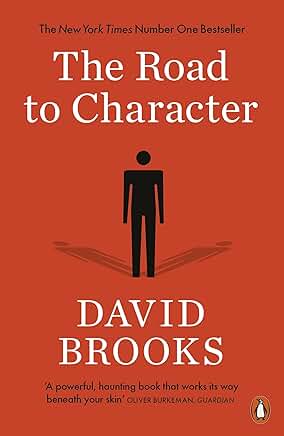
The Road to Character by David Brook
Summary
In The Road to Character, David Brooks distinguishes two types of virtues: résumé virtues (skills and achievements that get you ahead) and eulogy virtues (the moral qualities people remember when you’re gone). The book is a call to rediscover humility, self-discipline, and moral purpose in a culture increasingly driven by self-promotion and individualism.
Key Insights
The Inner and Outer Self
- Résumé virtues are about success; eulogy virtues are about moral worth.
- Today’s culture prizes “Look at me, I’m special” over “No one is better than me, and I am no better than anyone else.”
- Character must be built, not presumed.
The Practice of Moral Development
- Failure leads to humility; success can lead to pride.
- Self-respect comes from keeping commitments to oneself.
- Moral growth comes from imitating admirable people over time.
- Practice daily acts of self-discipline and cultivate the habit of truthfulness.
- Avoid temptation—don’t rely on self-control alone.
The Humility Code
Brooks summarises his moral vision in what he calls the “Humility Code”:
- Seek holiness, not happiness—the former leads to the latter.
- Recognise:
- I am flawed, selfish, prone to cowardice and deceit.
- I rationalise my faults and overestimate my virtues.
- I aspire to be good despite these flaws.
- Humility is a clear-eyed assessment of one’s place in the world.
- Once basic needs are met, the real battle is for virtue over sin.
- True character is forged by 1,000 small acts of self-restraint.
Reflections from History and Faith
- Samuel Johnson, born blind in one eye and deaf in one ear, exemplified resilience and truthfulness: “The first step to greatness is honesty.” And he suffered from Tourette’s.
- Eisenhower: “Anger cannot win. It cannot even think clearly.”
- C.S. Lewis: Trying to impress people fails. Focusing on others works.
- Augustine: A fool pleases himself; true moral growth involves self-confrontation.
- Peale’s “Positive Thinking” model focuses on self-love and affirmation, while Brooks favours the older model of inner combat, against laziness, pride, and greed.
Notes
- Résumé vs eulogy virtues
- Failure cultivates humility
- Practice 1,000 small acts of self-control
- “Seek holiness, not happiness”
- Self-deception: I’m special, I’m better
- Avoid temptation—don’t rely on willpower
- Truthfulness and civility matter
- “The first step to greatness is honesty”
- Inner combat beats self-congratulation
- A leader sees others as prone to weakness—just like himself
Strengths
- Philosophical Depth:
Brooks draws richly from theology, biography, and moral philosophy. - Countercultural Message:
The book pushes back against modern narcissism with a powerful call to humility. - Accessible Moral Framework:
The Humility Code is both convicting and inspiring.
Weaknesses
- Moralistic Tone:
Some readers may find the tone heavy or sermon-like in places. - Selective Heroism:
Biographical examples sometimes idealise flawed individuals.
Reflections
This is a good book. Brooks argues from the heart. He challenges readers to step off the treadmill of ego and embark on a lifelong journey to become a better person.
His reminder that “information doesn’t make us better—love does” is one of the most moving takeaways.
Some of the criticism of Eisenhower is fair, but I admire him. As a general, he had his failures, yet as Supreme Commander of a vast, multi-national force, he was superb. Few could have managed the egos and ambitions of Montgomery, Patton, and de Gaulle, not to mention Churchill constantly in his ear. Eisenhower showed immense patience and steady judgment. But he was not without flaws: he had an affair, and his lover was, as far as we know, dropped unceremoniously once his life moved on. Schindler, for another example, was a philanderer, and yet he risked his life to save others because he thought it was right. People are complicated: capable of greatness and weakness, sometimes in the very same breath.
Conclusion
The Road to Character is a timely invitation to shift focus from performance to purpose, from vanity to virtue. Character is not innate. It is earned, slowly, painfully, and through love and effort.
Book Details
Title: The Road to Character
Author: David Brook
Publication Year: 2016
Genre: Social Psychology
Reference: Calandra Vol. 4 p. 42
← Previous: Vital Lies, Simple truths by Daniel Goleman