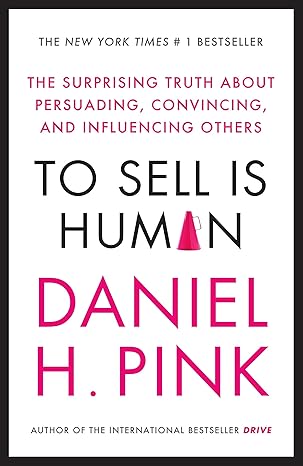
To Sell is Human by Daniel Pink
Summary
Daniel Pink redefines selling as something that all of us do, not just salespeople. At its heart, selling is persuading someone to part with their resources, not to deprive them but to leave them better off. Whether convincing colleagues, motivating a team, or pitching a product, we are constantly influencing and persuading. Pink explores how sales have evolved in the era of transparent information, why empathy and perspective-taking are more crucial than the old “Always Be Closing” mantra, and how modern selling is ultimately about serving others first.
Key Insights
Everyone sells: Persuading, influencing, and convincing are universal activities—whether asking for someone’s time, attention, or commitment.
Information symmetry: The old asymmetry of knowledge, where the seller knew more than the customer, has eroded thanks to reviews, research, and digital transparency. Customers now hold the power.
Honesty as advantage: Dishonest dealing drives out honest dealing; transparency and fairness build long-term trust. CarMax’s fixed-price model exemplifies this shift.
Empathy and perspective: Empathy is valuable, but perspective—seeing what the other side is thinking—is even more effective. Mimicry, word-for-word repetition, and humility help create rapport.
Ambiverts excel: The best persuaders are not extreme extroverts or introverts but ambiverts, who balance assertiveness with listening.
The power of questions: Declarative self-talk (“I am the best”) is weaker than interrogative self-talk (“Will I succeed?”). Asking questions engages the brain to generate answers and boosts motivation.
Optimism with realism: Positive emotions should outweigh negative ones 3:1, but extreme optimism blinds us. Setbacks should be seen as temporary, specific, and external—not permanent, pervasive, and personal.
Problem finding > problem solving: The most valuable skill is identifying the right problem. A well-framed problem leads naturally to profitable solutions.
Clarity and contrast: Persuasion depends on framing and contrast. Labels matter, blemishes can increase trust, and specific, concrete language persuades better than vague promises.
Story and pitch: A strong pitch can be a rhyme, a tweet, a haiku, or a Pixar-style story. What matters is clarity—what do you want people to know, do, and feel?
Improv skills: “Yes, and…” builds collaboration and trust; “Yes, but…” shuts it down. Good sellers listen, adapt, and make their partner look good.
Humanising others: Seeing the patient’s face helps radiologists diagnose better. Appeals framed around helping others (e.g., hygiene protects patients) motivate behaviour more than self-interest.
Serve first, sell second: Pink’s core lesson is to act as if the customer is doing us a favour. Treat people with dignity, empathy, and service-mindedness—this builds lasting persuasion.
Strengths
Broad relevance: Pink demonstrates that persuasion is not confined to traditional sales but is central to all work and life.
Memorable examples: From Joe Girard’s quirky cold calls to Otis’s elevator demo, Pink illustrates principles with vivid stories.
Practical techniques: The book offers actionable strategies—self-talk, framing, pitching formats, improv exercises—that can be applied immediately.
Human-centred approach: By grounding persuasion in empathy and service, Pink makes selling feel ethical and collaborative.
Weaknesses
Wide-ranging but scattered: The book touches many ideas, sometimes at the expense of depth.
Optimism balance: While Pink cautions against excessive optimism, some readers may find the emphasis on positivity oversimplified.
Problem-finding challenge: The concept is powerful but less practical—Pink stresses its importance without always showing how to cultivate it systematically.
Reflections
I found Pink’s reframing of sales as universal, both liberating and sobering. It reminded me that I am always “selling”, whether persuading others to give me their time, support, or resources. His emphasis on perspective resonates strongly: it’s not enough to feel what others feel; I must see what they see.
The lesson that setbacks are temporary and external is invaluable for resilience, as is the advice to replace “I am useless” with “I didn’t perform well today.” I particularly liked the improv principle of “Yes, and”; a simple but transformative approach to communication.
Above all, the message to serve first, sell second resonates. To persuade ethically, I should act as though I am dealing with someone I love. This not only honours the other person but also ensures that persuasion leaves both sides better off.
Conclusion
To Sell is Human is a thoughtful and practical exploration of persuasion in everyday life. Pink replaces the old caricature of the pushy salesman with a model grounded in empathy, clarity, and service. While not every tool is equally strong, the central message, that selling well makes others better off, makes the book both ethical and empowering.
Book Details
Title: To Sell is Human: The Surprising Truth About Persuading, Convincing, and Influencing Others
Author: Daniel Pink
Publication Year: 2014
Genre: Sales
Reference: Skylark 6. p. 29