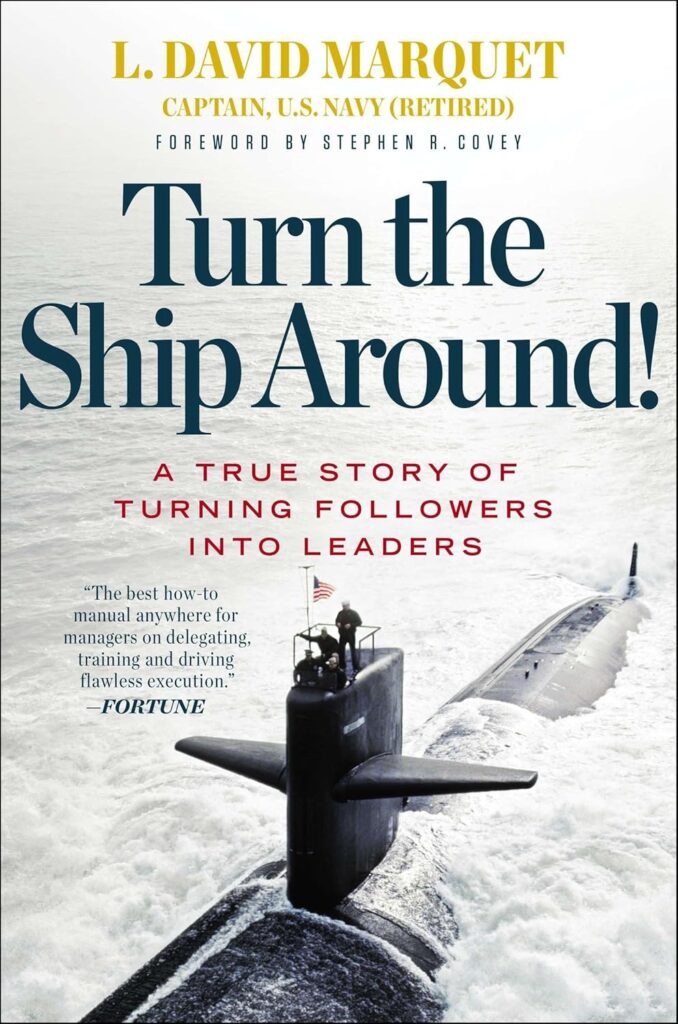
Turn the Ship Around! by L. David Marquet
Summary
Marquet rejects the traditional leader–follower model and replaces it with leader–leader: push authority to where the information lives, grow competence at every level, and build clarity around purpose. Real leadership is measured not by what happens with the boss, but by what endures after the boss leaves. The aim isn’t error-avoidance; it’s excellence.
Key Insights
Leader–Leader, Not Leader–Follower
- You can buy time, not loyalty or commitment—those are given, not taken.
- Leaders convey people’s abilities and potential, connecting daily tasks to a larger purpose.
- Success after departure is the test: if performance drops when you leave, you didn’t build the system.
Push Authority to Information
- “Don’t move information to authority; move authority to information.”
- Replace permission-seeking with ownership:
- Weak: “Could we… do you think… may I?”
- Strong: “I intend to…”, “I plan to…”, with the reason.
- Ship work early: drafts → review → iterate. Short, early conversations beat late, perfect plans.
- “A little rudder far from the rocks is better than a lot of rudder close to the rocks.”
Competence + Clarity (or it collapses)
- Control without competence is chaos. Empowerment only works if people can execute.
- Specify goals, not methods; make guiding principles real, not wall art.
- Inspections should be outcomes of excellence, not the goal.
From Training to Learning
- “I am trained” is passive; learning is active.
- Don’t brief—certify: leaders ask questions to confirm the team truly understands the task.
- If they can’t answer, they’re not ready.
- Repeat key messages; don’t assume one telling is enough.
Deliberate Action (Shisa Kanko)
- Avoid autopilot. Use say–pause–do (point and call): state the control/action, pause, execute.
- Apply to operations and admin (don’t sign blindly).
Culture: From Fear to Excellence
- Focusing on not making mistakes breeds minimal effort and passivity.
- Encourage initiative (act without direction, solve, prepare).
- Openness: everyone can speak candidly.
- Integrity: always tell the truth—no hedging.
- Unpunctuality often signals deeper system issues—treat causes, not symptoms.
- Welcome inspectors as learning partners; uncertainty can be a strength.
Strengths
A crisp, practicable operating system for teams (intent, certification, deliberate action).
Reframes leadership as system design: competence + clarity + control.
Emphasises ownership and continuous improvement over performative compliance.
Weaknesses
Organisations steeped in command-and-control may need transitional scaffolding not fully detailed here.
“I intend to” works best where mission and guardrails are crystal clear—leaders must invest heavily in that clarity.
Reflections
The shift from “avoid errors” to “achieve excellence” is the book’s hinge. The “I intend to… because…” habit, coupled with certification and deliberate action, turns passive executors into thinking owners. Most memorable is Marquet’s scoreboard: what happens after you’re gone? That’s the honest audit of leadership.
Conclusion
Turn the Ship Around! is a field manual for building autonomous, high-competence teams. Push control to the edge, grow capability, clarify purpose, and make excellence the default. Do that and the ship keeps sailing straight long after the captain steps off the bridge.
Book Details
Title: Turn the Ship Around!: A True Story of Building Leaders by Breaking the Rules
Author: L. David Marquet
Publication Year: 2013
Genre: Decision making
Reference: Calandra 6
← Previous: Water Logic by Edward de Bono