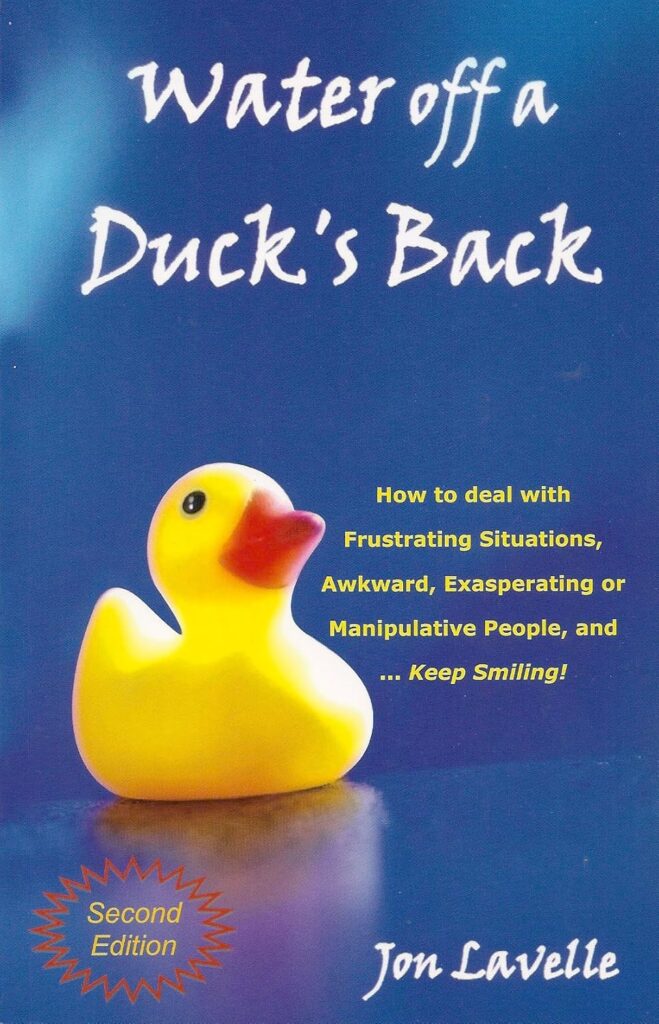
Water Off a Duck’s Back by Jon Lavelle
Summary
Jon Lavelle’s Water off a Duck’s Back is a guide to emotional self-mastery and resilience. The central theme is that while we cannot control other people’s behaviour, we can control our responses. Lavelle argues that our greatest freedom lies in choosing how to react to provocation, insult, or mistreatment. By consciously managing our emotions, we maintain our dignity and preserve our mental well-being.
Key Insights
Reaction is a choice: Anger, humiliation, or guilt are emotions we allow ourselves to feel; nobody can force them upon us. We decide whether to hand victory to the aggressor or retain control.
Provocation is a test of control: Responding to aggression or insult concedes power. Silence, humour, or deflection can be stronger tools than retaliation.
Perspective matters: On a scale of one to 100, most slights are trivial compared to genuine crises. Why waste energy being angry over a stranger’s insult when surrounded by affection from loved ones?
Language as a tool: “Space-giving words” such as maybe, possibly, or that’s interesting keep options open, reduce confrontation, and restore composure.
Challenge exaggeration: Absolute terms like everyone, no one, or always should be questioned; they distort reality and fuel conflict.
Control your state: We can deliberately choose to be optimistic, confident, and resilient. Consciously shifting attention to positive thoughts or imagined future events creates real improvements in mood.
Don’t rehearse anger: Ruminating on grievances only prolongs self-harm. Treat annoyances as distant, low-quality background noise rather than central concerns.
Nourish positivity: Fitness, laughter, kindness, and making others smile are natural, energising “drugs” that improve our outlook.
Boundaries of concern: Don’t get riled about matters that don’t affect you—focus on what’s within your sphere of control.
Strengths
Actionable advice: The book is full of practical strategies—phrases, reframing techniques, and mental exercises—that can be applied immediately.
Clarity of thought: Lavelle frames emotional control as a simple but powerful discipline: it’s not what others do, but how I react.
Psychological realism: He acknowledges the difficulty of staying calm under provocation but insists that mastery is possible with practice.
Positive emphasis: The book balances self-protection with proactive well-being—building optimism, showing kindness, and seeking joy.
Weaknesses
Repetition: Many points are variations on the same theme, which can feel circular.
Simplification: While empowering, the idea that we can always choose our feelings may understate the complexity of trauma, depression, or deeply ingrained responses.
Limited context: The book is focused on individual resilience but gives less attention to systemic or relational dynamics that also shape conflict.
Reflections
Lavelle’s philosophy is reminiscent of Stoicism and Viktor Frankl’s Man’s Search for Meaning: freedom lies in the gap between stimulus and response. The advice to use humour, silence, or perspective when confronted with insults is timeless. I particularly like the metaphor of treating an annoying person as a “small black-and-white TV crackling in the distance”—a reminder to downgrade their importance in my mind.
Equally valuable is his insistence on cultivating positive states proactively. Rather than waiting for life to dictate our mood, we can choose to be energised, resilient, and optimistic. The warning against “dementors”—people who sap our energy—is sharp and memorable.
Overall, Water off a Duck’s Back is a compact but insightful manual for emotional resilience, reminding us that dignity, peace, and happiness depend less on others and more on the control we exert over ourselves.
Conclusion
This book is a strong, practical reminder that control of our inner life is the foundation of freedom. By choosing our reactions, challenging distortions, and cultivating positivity, we develop resilience in the face of life’s challenges. Not every strategy will suit every situation, but the central lesson, that nobody can make us feel anything without our consent, is a liberating truth worth carrying.
Book Details
Title: Water Off a Duck’s Back: How to Deal with Frustrating Situations, Awkward, Exasperating and Manipulative People and… Keep Smiling!
Author: Jon Lavelle
Publication Year: 2008
Genre: Self-help
Reference: Skylark 6, p. 28
← Previous: Full Engagement by Brian Tracy