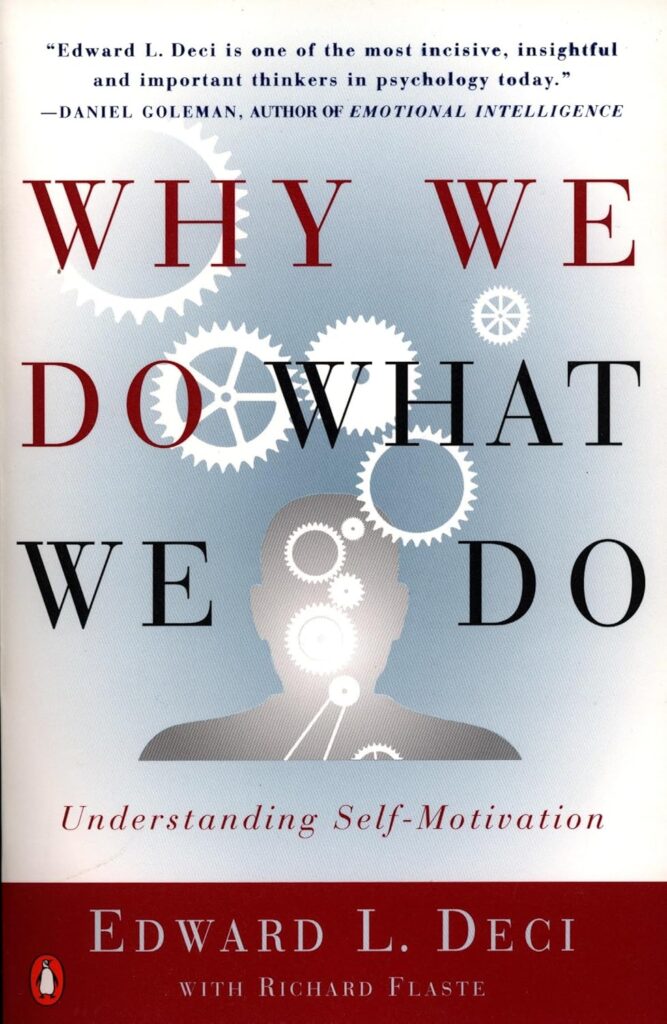
Why do We do what We do by Edward L. Deci
Summary
Edward Deci’s Why We Do What We Do explores human motivation. He argues that autonomy, the sense of acting by one’s own choice, is the key to lasting engagement and growth. Rewards, punishments, and other external controls can produce short-term compliance, but in the long term, they result in passivity, resentment, and “reward dependency”. People work not because they want to and enjoy it, but for the rewards they receive. Deci argues that leaders should cultivate environments where people motivate themselves, balancing freedom with appropriate structure.
Key Insights
Autonomy vs. Control: People thrive when they feel their choices matter. Control (through rewards, threats, surveillance, or deadlines) provokes either compliance or defiance, not genuine motivation.
Intrinsic vs. Extrinsic Motivation: Intrinsic motivation (curiosity, mastery, enjoyment) produces deeper, better learning and performance than extrinsic motivation (grades, bonuses, punishments).
The Power of Choice: Even small, meaningful choices increase motivation and commitment. Choice should be appropriate to the person and circumstances.
Rewards and Threats: Rewards are often interpreted as control. Money and competition can temporarily motivate, but they sap intrinsic interest once the external incentive disappears.
Competence Matters: People are motivated when they feel competent in their environment. Praise can help — but only if it is genuine, non-controlling, and respectful.
Self-Esteem: When self-worth is tied to achievement (ego involvement), people become fragile, anxious, and defensive. Secure self-esteem allows for failure without loss of identity.
Applications:
Education: Grades encourage rote learning. Real motivation comes from applying knowledge and feeling ownership of learning.
Work: Employees perform best when they feel autonomous and competent, not micromanaged. Delegation and goal-setting are more effective when employees participate.
Medicine: Patients are more likely to follow treatment plans when they feel autonomous in decision-making.
Personal Growth: Autonomy is not independence, but responsibility for one’s choices and values.
Strengths
Clear, practical message: Deci persuasively shows why autonomy is essential in classrooms, workplaces, and families.
Relevance across domains: The same principles apply to business, education, health, and personal life.
Examples and anecdotes: From puzzles to bonuses, Deci illustrates how rewards and threats backfire.
Moral seriousness: The book is not only about productivity but about dignity, respect, and human flourishing.
Weaknesses
Repetitive: The central argument is restated many times, making the book feel longer than necessary.
Limited nuance: While Deci acknowledges that some external controls are unavoidable, his guidance on balancing autonomy with necessary structure is sometimes vague.
Dated style: Written in the 1990s, the book occasionally feels more polemical than research-driven compared with modern psychology texts.
Reflections
Deci’s distinction between intrinsic and extrinsic motivation is important. Money, he argues, is not a proper motivator. Financial incentives often distort behaviour, leading people to take shortcuts or lose interest once the bonus disappears.
His emphasis on autonomy is also worth noting. To be trusted, to be allowed to own one’s work or learning, is far more motivating than being told what to do. It is autonomy, not independence, that counts.
There’s a fair amount of repetition, but Deci is entitled to keep pressing his point. In a culture obsessed with rewards and rankings, his message needs frequent repetition.
Conclusion
Why We Do What We Do, at the time of its publication, was a groundbreaking discussion of motivation. Its central message, to facilitate autonomy, build competence, and nurture intrinsic motivation, remains as relevant today as when it was first written. One curious observation stood out: Deci noted that men and women reacted differently to praise. For men, praise tended to enhance intrinsic motivation; for women, it tended to diminish it. Deci did not fully explain why, and it may be that with the social changes of recent decades, this discrepancy has since disappeared.
Book Details
Title: Why do We do what We do: Understanding Self Motivation
Author: Edward L. Deci
Publication Year: 1996
Genre: Psychology
Reference: Skylark 6, p. 8